
De-Escalation: Creating Distance Before a Situation Becomes Physical
In my previous article, I discussed situational awareness, recognising what is happening around you and identifying potential problems early.
But awareness is only the beginning.
Once you recognise that a situation may be escalating, the next question is:
What can you do to prevent it from becoming physical?
In self-defence, we sometimes focus too much on what to do once someone throws a punch, grabs us or produces a weapon. In reality, one of the most valuable skills we can develop is the ability to recognise escalation early and manage the situation before physical force becomes necessary.
Two of the most important tools are distance and verbal de-escalation.
Distance Gives You Time
One of the first principles I teach in personal protection is simple:
Distance equals time, and time gives you options.
If someone is becoming aggressive, angry or threatening, allowing them to move unnecessarily close to you dramatically reduces your reaction time.
The closer someone gets, the less time you have to recognise and respond to a sudden punch, grab, headbutt or other aggressive action.
Maintaining an appropriate distance isn't about appearing frightened or confrontational. It is about creating a safety buffer.
If possible, move back, angle away and avoid allowing yourself to become trapped against a wall, vehicle, table or other obstacle.
You should also be aware of where your exits are.
Your objective isn't to stand your ground to prove something.
Your objective is to stay safe.
Your Body Language Matters
How you position yourself can either calm a situation or unintentionally escalate it.
Standing directly in someone's face with clenched fists and aggressive body language can communicate that you are ready to fight.
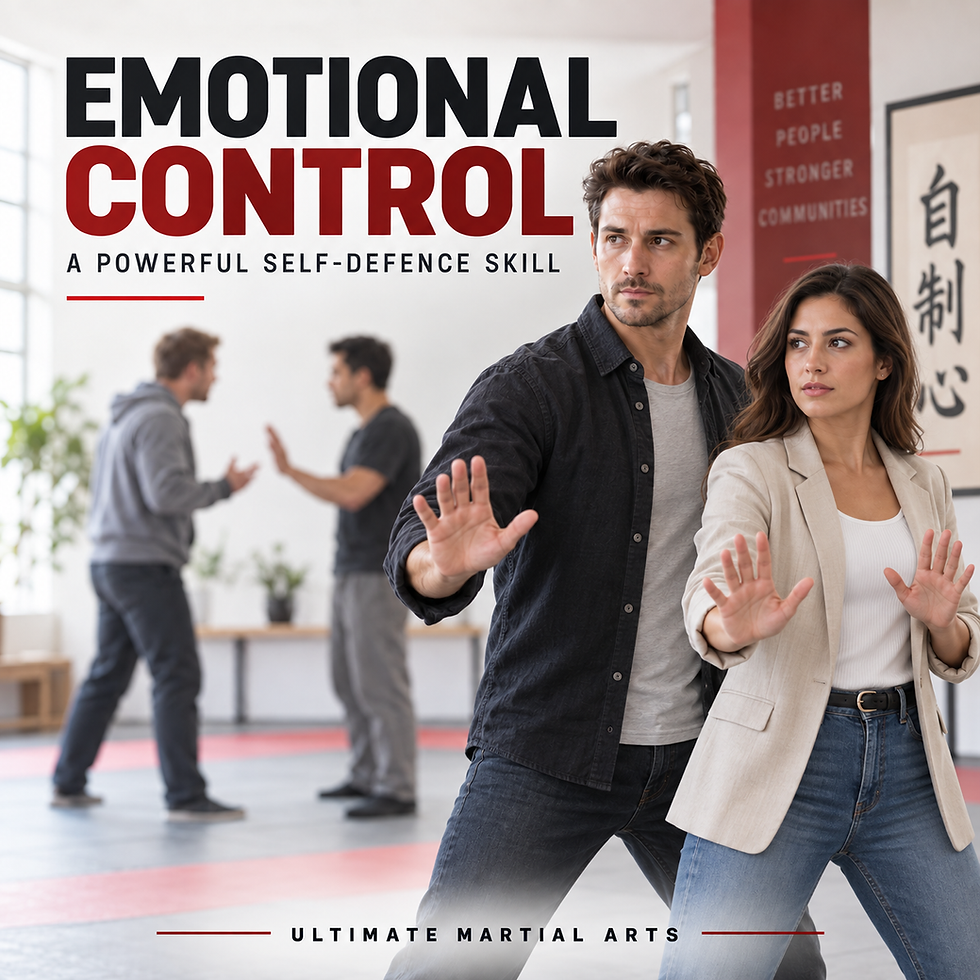
Instead, consider adopting a natural, non-threatening position with your hands visible and slightly raised.
This allows you to communicate while also maintaining a safer physical position.
Your posture should communicate:
"I don't want trouble, but I am aware of what is happening."
This is very different from either appearing aggressive or completely passive.
Use Your Voice Before Your Hands
Verbal de-escalation is one of the most overlooked self-defence skills.
When emotions are high, arguing about who is right often makes things worse.
The objective of de-escalation isn't to win the argument.
The objective is to prevent the situation from becoming violent.
Keep your voice controlled. Avoid insults, threats and challenges. Don't allow someone else's aggression to dictate your emotional state.
Simple statements can be very effective:
"Mate, I don't want any trouble."
"It's okay. I'm moving away."
"Let's leave it there."
"I understand you're angry."
"Give me some space, please."
These aren't signs of weakness.
They are signs that you are maintaining control of yourself while attempting to lower the emotional temperature of the situation.
Set Clear Boundaries
De-escalation doesn't mean allowing someone to intimidate you or continually invade your personal space.
There may come a point where your communication needs to become firmer.
"Stop there."
"Don't come any closer."
"Stay back."
Clear verbal boundaries can serve several purposes. They communicate that you don't want physical confrontation, they may discourage further aggression, and they can also alert people around you that something is wrong.
Your tone should be confident and deliberate without becoming unnecessarily aggressive.
Don't Let Ego Make the Decision
Many confrontations escalate because neither person wants to back down.
Someone says something disrespectful.
Someone bumps into someone.
Someone feels challenged.
Suddenly, a situation that could have ended in seconds becomes a physical confrontation.
One of the most important lessons martial arts can teach us is that walking away is not weakness.
You don't need to win every argument.
You don't need to respond to every insult.
You don't need to prove how tough you are.
Real confidence is having the ability to protect yourself while also having the discipline not to fight when you don't need to.
Watch for the Change
While you are communicating, you must continue observing the person's behaviour.
Are they calming down?
Or are they becoming more agitated?
Watch for changes such as sudden movement towards you, repeated closing of distance, clenched fists, looking around, changes in breathing, aggressive gestures or ignoring your requests to stay back.
These behaviours may indicate that verbal communication is no longer working.
This is why situational awareness and de-escalation work together.
You are constantly observing, assessing and adjusting.
Awareness → Distance → Communication → Exit
A simple way to remember the process is:
Awareness → Distance → Communication → Exit
Recognise the potential problem early.
Create space.
Communicate calmly and confidently.
Look for an opportunity to disengage and leave.
Physical self-defence should be the option we use when avoidance and de-escalation have failed, and we genuinely need to protect ourselves or another person.
At Ultimate Martial Arts, we believe effective self-defence isn't simply about learning how to fight.
It is about developing the awareness to recognise danger, the confidence to manage confrontation, the communication skills to de-escalate conflict and the physical ability to protect yourself when there is no other reasonable option.
The best confrontation is often the one you recognise early enough to avoid.



Comments